Why AI Agencies Feel Saturated in 2025, and How to Win Anyway
AI agencies had an easy run when “AI automation” was new. In 2025, the market feels crowded because the tools are everywhere and most offers sound the same. This article breaks down what changed, why saturation is real, and how to create a unique mechanism that makes clients choose you.
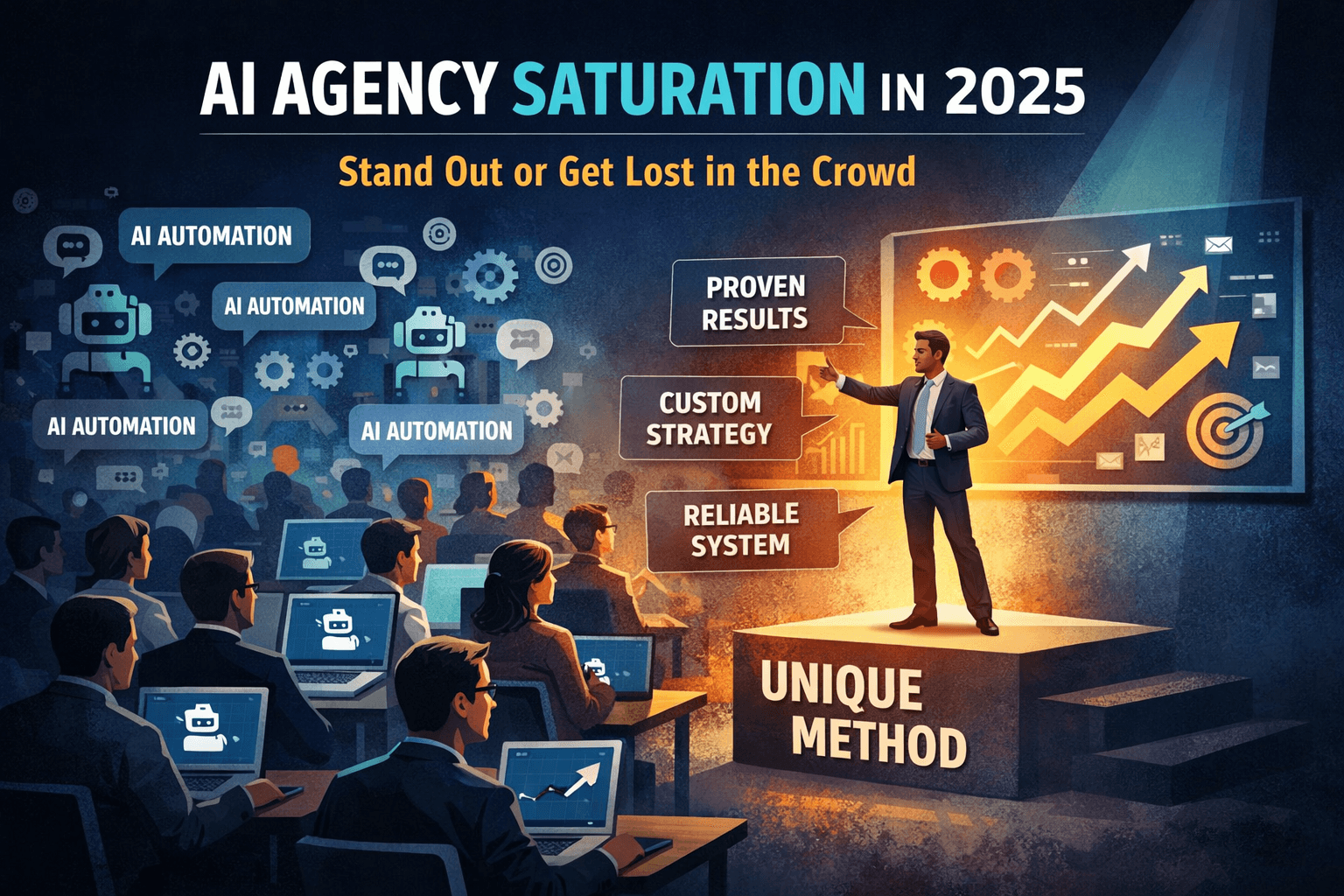
AI agencies changed fast in 2025
In 2023 and 2024, “AI automation” sounded new. Just saying you could build workflows with AI got attention. That era is over.
In 2025, most buyers have already seen AI demos. Many have already tried a chatbot. Many have already tried automating outreach. So the baseline expectation is higher.
This is why the market feels different now. It is not that demand disappeared. It is that the easy differentiation disappeared.
Why the market feels saturated
Saturation is not only about how many agencies exist. It is about how similar they look from the client’s point of view.
Most offers sound identical. Most websites say the same things. Most case studies show the same type of work.
Here are the biggest reasons it feels crowded.
1) The tools became the floor
Tools are easier to access than ever. Templates are everywhere. Tutorials are everywhere.
That changes what clients think is valuable. They start to believe the build is easy. They assume anyone can do it. So they stop paying for “we use these tools.”
2) The default offers got commoditized
A lot of agencies still sell the same bundle:
Chatbot.
Lead scraping.
Cold outreach automation.
Basic CRM integrations.
Even if you do it better, it looks the same at a glance. When the offer looks the same, the buyer compares on price. That is where people get stuck.
3) Buyers got more skeptical
Buyers are not anti AI. They are anti disappointment.
They have seen projects that “almost work.” They have seen agents hallucinate. They have seen automations break when one small input changes.
So now they ask different questions. They want reliability. They want guardrails. They want someone accountable when things fail.
The new rule in 2025
Your tool stack is not your edge anymore.
Your method is your edge.
Clients are not buying “n8n plus ChatGPT.” They are buying a repeatable way to get a result. They want a plan they can understand. They want something that feels proven.
That is where a unique mechanism wins.
What a unique mechanism is
A unique mechanism is your named way of getting results. It is not a vague promise. It is not “custom solutions.” It is not “we use AI.”
It is a system you can explain. It is a system you can repeat. It is a system the client can see.
A good mechanism has a few traits:
It is specific
It is repeatable
It is visible
It is tied to a metric
It is hard to copy quickly
If someone can copy your offer from a YouTube video in a weekend, it is not a mechanism. It is a workflow.
What clients actually pay for now
In 2025, clients pay for outcomes and certainty. They want to know what happens next. They want to know what happens when something breaks.
These are the value buckets that sell.
1) Reliability and quality control
People want automation that does not silently fail. They want monitoring. They want alerts. They want fallbacks.
They also want a clear owner. They want to know who fixes it and how fast.
2) Integration across messy systems
Real businesses are messy. They have spreadsheets. They have inboxes. They have two CRMs. They have random tools that nobody remembers.
The hard part is not the AI. The hard part is the plumbing. The hard part is getting clean inputs and consistent outputs.
3) Moving from pilot to real rollout
Many teams can run a demo. Fewer teams can roll it out across the business.
A winning agency helps clients move from “cool experiment” to “this is how we operate now.”
Unique mechanism ideas you can build around
Here are examples that create real differentiation. Do not copy the names. Use them as a pattern.
1) The Automation Profit Map
You run a short audit. You find the top 5 automation opportunities. You rank them by ROI. You assign a timeline and payback window.
The deliverable is a one page map. The client instantly sees what you are doing and why.
2) The Data Readiness Sprint
Before you build agents, you fix the inputs. You clean fields. You standardize naming. You remove duplicates. You define access rules.
This makes everything else work better. It also makes your work feel professional.
3) The Pilot to Production Ladder
You ship in stages. You start in sandbox. Then you run shadow mode. Then you go live.
Each stage has pass criteria. Each stage has monitoring. Each stage has a fallback plan.
4) The Human Review Queue
You add a human approval step where it matters. You route edge cases to a review inbox. You track patterns and improve prompts and rules over time.
This is how you increase trust fast. This is how you reduce risk.
5) The Inbox to System Engine
You convert email chaos into structured work. You auto tag. You route. You draft replies. You create tickets automatically.
The outcome is simple. Faster response times. Fewer dropped balls. Less mental overhead.
6) The Sales Ops Autopilot
Not “lead scraping.” A full operating system.
Lead capture. Enrichment. Routing. Follow up logic. Meeting prep briefs. CRM hygiene. Reporting.
This is what buyers actually want. They want a machine, not a hack.
A positioning formula that works
Use this format. Keep it simple.
We help (specific customer) achieve (measurable outcome) using (named mechanism).
Examples:
We help property managers cut response time using the Inbox to System Engine.
We help B2B agencies increase booked calls using the Sales Ops Autopilot.
We help accounting firms reduce manual work using the Automation Profit Map.
How to build your mechanism in 7 days
You do not need a perfect brand first. You need clarity and proof.
Day 1: Pick one customer type. Pick one workflow.
Day 2: Map the current process step by step.
Day 3: Design the mechanism assets. Create the scorecard, ladder, dashboard, or queue.
Day 4: Build the smallest working version on real data.
Day 5: Add tests and edge case handling.
Day 6: Add monitoring and a fallback path.
Day 7: Package the offer into one page with a clear timeline and deliverables.
Offer rewrite checklist
If your offer feels generic, check these:
Do I promise a specific outcome, not a vague benefit?
Do I have a named mechanism, not “custom solutions”?
Can the client see what they get in the first week?
Do I include monitoring, ownership, and fallback plans?
Do I have proof, even if it is small?
Does the offer feel hard to copy quickly?
The takeaway
Yes, the AI agency space is more competitive in 2025. That is real.
But saturation is not a dead end. It is a filter.
If you keep selling tools, you will blend in. If you sell a clear mechanism tied to a measurable result, you will stand out.
